

*Note on the name: During the course of preparing this article, it has come to light that Johnny Sack’s name is actually spelled Johnnie. As many German immigrants before him, it is likely that his name was anglicized to Johnny at some point, and Johnny has been used ever since. In the interest of historical accuracy, we will use Johnnie in this article.
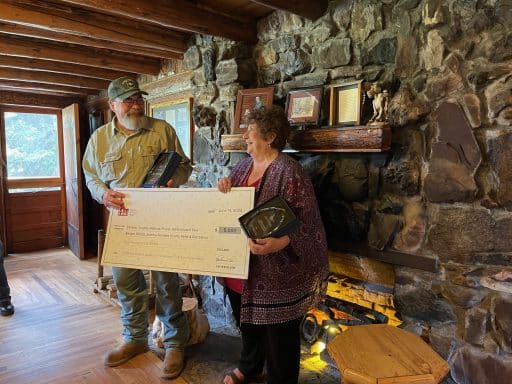
At a ceremony on-site in Island Park, ID on June 14th, representatives from the Caribou- Targhee National Forest, Ashton/Island Park Ranger District, and Fremont County Parks & Recreation received the second annual Idaho Heritage Trust (IHT) Fred Walters Award for Excellence in Historic Preservation for their conscientious work preserving the Historic Johnnie Sack Cabin, the longtime home of one of Idaho’s true characters and the embodiment of our state’s frontier spirit.
Born in Germany, Johnnie came to the United States as a young boy, and his family first settled in Indiana, where he and his father built wagons for the Studebaker Corporation in South Bend, Indiana. The Studebaker family were themselves German immigrants, first arriving in Philadelphia in 1736, then quickly acquired vast amounts of land on which they established industrial farms and manufacturing plants. By the time Johnnie’s family arrived in Indiana, the era of the horse-drawn wagon was coming to a close. In 1895, the Studebakers began to develop horseless carriages, first opting for an early electric propulsion model, before switching to gasoline engines. By 1918, production of automobiles outstripped their wagons.
Perhaps seeing the writing on the wall, Johnnie and his brother decided to head West to seek their fortunes in 1909. At the age of 24, Johnnie traveled by one of the first railroad cars through Yellowstone and into Idaho, arriving in the middle of a blizzard in June. The Sacks homesteaded on 160 acres of land on the East side of the Henry’s Lake outlet with the goal of raising a herd of cows and establishing a dairy. According to IHT Trustee Emeritus Tom Howell, whose cousin used to babysit for Johnnie’s brother Andy, shipping dairy products out of the area was much more difficult than they’d anticipated, and the harsh winters caused the trainlines to shut down completely.
Johnnie spent time working for various ranchers and even joined the military, but he eventually fell back on his immense talent as a carpenter and craftsman to help make ends meet. As a result, you can still find some of Johnnie’s distinctive handcrafted furniture in many of the homes of a certain age throughout the Island Park area, as well as the treasure-trove of masterworks still in his cabin.
In 1929, Johnnie leased a tract of land from the National Forest Service for $4.15 a year and began construction of his cabin in 1932. The bungalow-style cabin was completed approximately three years later and is similar in form to the prevailing style of construction in Idaho at the time, featuring a pitched roof, extended eves, exposed rafters, and chopped gables. The 20’x27’ floorplan features two porches, a deck (where one could often catch Johnnie smoking his pipe with his faithful dog, Luna), a sitting room, kitchen, and washroom on the first floor. The second floor consists of two small bedrooms and some storage space, while the cellar is home to Johnnie’s workshop. Though the form may be somewhat typical of the period and style, the exquisite craftsmanship is anything but. The nomination for the cabin’s listing in the National Register of Historic Places describes it:
During this period (1920-1950) the use of the log cabin motif became popular among rusticating Idahoans seeking peace and tranquility in the sylvan confines of Idaho’s mountain regions. The Sack cabin, with its exquisite craftsmanship, is one of the more remarkable examples of its genre encountered in our state site survey to date.
Johnnie utilized a number of remarkable techniques to create the intricate details and rich finishes you can see throughout the interior of his home. Johnnie repurposed split bark from logs, scrap wood from other projects, odd-shaped tree limbs, knot-riddled timber, pinecones, and all sorts of other odds and ends to create truly unique architectural details and furnishings. One of his ceiling lamps, still in its original location, is constructed from seventy-two individual pieces of wood, while the double bed in the larger of the upstairs bedroom is comprised of ninety-six separate pieces. Even everyday pieces like lampstands, magazine racks, window frames, tables, and chairs feature pine paneling, bark inlays, and other delicate details. Even the floors are varied works of art, following quilting patterns Johnnie learned from his grandmother back in Germany.
Firsthand accounts from those who knew him reveal Johnnie to have every bit as much character as the place he called home. Johnnie was a man of small stature, standing a mere 4’11’’. In flagrant disregard for the lease agreement for his cabin, Johnnie was Big Springs’ sole winter resident. He would often don his cross-country skis or snowshoes to go pick up his mail, see his friends at Mack’s Inn or Pond’s Lodge, and he was a frequent fixture at various poker tables. A committed bachelor, Johnnie was quoted as saying, ‘A woman would just put rugs on my varnished floors and draperies over my picture windows,’ leaving little mystery to why he never married.
Not long after Johnnie completed the work on his cabin, he dammed part of the river and constructed an ingenious waterwheel. The wheel provided ample electricity to power both his cabin and several of his neighbors’ as well. This, too, was never officially permitted, to the surprise of exactly no one. In fact, Johnnie campaigned heavily against the construction of an electrical grid in the area in 1940. He was incensed at the idea of paying a guaranteed
$2 a month, claiming it to be ‘highway robbery’. His vehement opposition has led to speculation that he intended to expand his waterwheel and sell access to electricity on his own, or to possibly create a cottage industry out of building similar hydroelectric power sources for others in the area, though this has never been confirmed.
This was far from the only political agitation for which Johnnie was known. He staunchly opposed the damming of Henry’s Lake. Records show his routine appearance at council meetings, where he would loudly express his opinion, declare that was the last he would say on the subject, and storm out. Then, like clockwork, he would appear at the next meeting and repeat the performance. In a delightful twist, once the dam was in place, Johnnie became the watermaster for the area.
Despite his somewhat cantankerous reputation, Johnnie was also quite the welcoming host and his cabin served as a visitor center of sorts for the influx of vacationers enjoying a rustic getaway from urban life. As noted, the other parcels of land leased during the time were specifically for part-time residents and signified a cultural shift in holiday habits for both the rich and middle classes alike. Railroad Ranch, owned by the Guggenheims and Harrimans, was not far away, and a resort inn was erected by the Kooch family in the 1920s. The National Register nomination describes this as such:
The log cabin motif with its associations with rustic life became a prime symbol of the roughing holiday seeker as the actualities of pioneer life retreated into the realm of nostalgia.
Fitting, then, that the ‘most pretentious’ of these cabins was also home to another prime symbol of rustic life, the indomitable bearded frontiersman, carving out a living with sheer skill and determination, making wonderful works of functional art from scraps of bark and gnarled limbs.
Johnnie passed away in 1957, and his surviving sisters cared for the cabin for several years, until Rudy and Alberta Kipp, a couple from California, purchased the cabin sight unseen knowing full-well the land’s lease was up and the cabin would be removed in 1979. They spent 17 summers in the cabin, barely changing a thing, which is all the more impressive knowing Rudy stood a full 6’2’’ and somehow put up with the small, handcrafted, almost- double bed Johnnie had fashioned for himself. They even made do with the antique wood stove, however they did add a makeshift shower and chemical toilet to supplement the washroom’s sink and bathtub.
By 1979, Johnnie’s cabin was the last of what were once many cabins in the area. The US Forest Service wanted to open the area up for public recreation, and that would be much easier without having to manage property lines, water rights, and other concerns surrounding hikers, campers, and backpackers roaming through people’s private residences. Such would have been the fate of this particular gem were it not for the concreted effort of several of the people honored with our award, as well as an outpouring of community support. A nonprofit organization was created in 1980 to help facilitate the transfer, but that organization has since lapsed, and by 2005 the cabin was in dire need of repairs and was in danger of collapsing altogether. IHT Trustee Tom Howell uncovered the original paperwork outlining the agreement between the nonprofit and USFS, establishing legal precedent for keeping and maintaining the cabin. He worked with Tamra Cikaitoga, Director of Fremont County Parks & Recreation, and USFS District Ranger Bill Davis to navigate the complicated relationship between these entities and divide up responsibilities for caring for this treasure. The building and its contents are owned by the USFS, but day- to-day management, curation, and oversight of the preservation of the Johnnie Sack Cabin is performed by Tamra and her team of volunteers. This partnership allows for easier acceptance of donations and applications for grants, while also ensuring the land remains protected and open to the public.
Since the agreement went into effect in 2005, there have been a litany of projects both small and large. The USFS initially installed a series of French Drains to mitigate water damage to the lower logs and foundation, however rot had already took hold in more than a dozen of the massive logs, which had also made the beautiful floors buckle. Tamra ascribes the success of this early phase of the preservation to ‘having a really good contractor.’ That contractor happens to be Zane Abegglen, who has been carrying out historic preservation projects on the historic structures in Grand Teton National Park for about 30 years, including more than 80 different log structures. Tamra read an article about Zane’s work, and thought he would be the perfect fit, not just for his excellent work, but also for his experience navigating the complications of working on federally owned property.
Zane and his team used what are called grader blades, which can are slid between the cracks in the logs. The cabin is then lifted just enough to free the log, which is replaced with cement blocks until a replacement is fashioned and put back in place. Nearly the whole lower portion of the cabin had to be replaced, but thanks to the skill and attention to detail of Zane, the only real evidence of such extensive work being done is that the cabin is still standing today. It is also thanks to Zane that the waterwheel is turning again. Even though it was not in his specific remit, he was curious enough about the wheel to take the time to replace the bearings and do a few other small repairs.
There are a few more logs that will need to be replaced in the not-too-distant-future, but most of the recent preservation work has been focused on the waterwheel house and various details within the home – mainly the furnishings and flourishes. Tamra has even taken to finding suitable sticks to match the curtain rods seen throughout the rest of the cabin. The rest of the work is coordinated by Tamra and split between Forest Service and County employees, volunteers from the Fremont County Historical Society, or outside contractors like Zane, and they continue to chip away at issues as they arise, ensuring the cabin is well taken care of for the foreseeable future.
Much like how Johnnie used to open his cabin up to visitors, his home still serves as a visitor center for the greater Caribou-Targhee National Forest and Big Springs Recreation Area from June through September each year. Before the bulk of the preservation work began in 2006, the cabin saw barely 2,000 visitors per year. Last summer saw over 18,000 people darken Johnnie’s door, and that number is sure to increase as Tamra and her colleagues continue to distribute brochures, make connections with other sites in the county, and facilitate school trips when the weather allows. Because of the painstaking work of all those involved in caring for the Johnnie Sack Cabin, it is still common to hear visitors say ‘It’s just like how I remembered’ now more than 65 years removed from its original owner.
Thank you kindly to Tamra Cikitoga, Tom Howell, and Zane Abegglan for their time and thoughts in preparing this article, and we again extend our thanks and appreciation to them and Ranger Bill Davis for their coordination in caring for this fascinating piece of Idaho history.
Learn more about Fremont County recreation opportunities at About the FCHS | Fremont County Historical Society and keep up on all the happenings in the area from Ann Anthony’s Island Park News.
You can also discover more about the Caribou-Targhee National Forest – Home (usda.gov) and plan your next trip to see Johnnie’s home.