
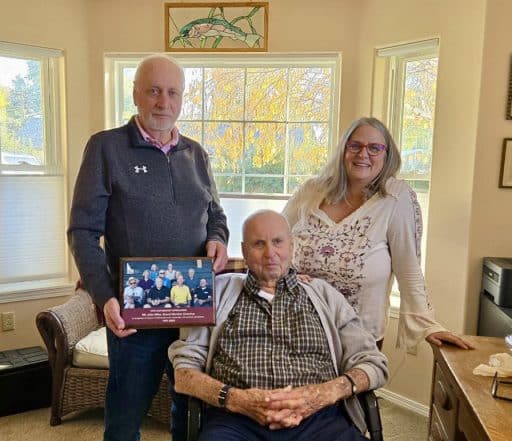
The Idaho Heritage Trust Board of Directors has conferred upon Mr. John Hiler the distinct honor of being our first ever Board Member Emeritus for his distinguished service to the Trust for more than three decades. Mr. Hiler has dedicated an untold amount of time and effort for the good of our organization and the people of Idaho – past, present, and future. It is without a doubt that IHT would not be in the place we are today without his innumerable contributions.
A fixture of the Mountain Home business community since 1961, Mr. Hiler was appointed to the Centennial Committee by then-governor Cecil Andrus. He was one of the first people appointed to the Idaho Heritage Trust and has spent more than three decades as an active member of IHT’s Board of Directors and serving in many leadership roles.
In this capacity, Mr. Hiler was instrumental in securing funding for the purchase of the Glade Creek Campsite, the last undeveloped campsite along the Lewis and Clark trail between Great Falls, Montana and Astoria, Oregon. Following the purchase from Plum Creek Timber Company, the pristine campsite was gifted to the State of Idaho to ensure its preservation for generations to come.
Mr. Hiler has also been a vocal advocate for the preservation, interpretation, and restoration of the Minidoka Concentration Camp used to house Japanese Americans during World War II. The proper treatment of this site has been a personal campaign for Mr. Hiler, as he says, “Historians must not just pass on the good but shine a light on the bad.” He continues, “Minidoka is important in this context, but is all the more important to me, because that is where they took many of my friends.”
In addition to his work with the Trust, Mr. Hiler has shown his lifelong dedication to preserving, protecting, and promoting Idaho’s cultural resources as a writer, self-styled, History Scientist, and advocate for historic preservation. While Mr. Hiler’s advocacy has had an outstanding impact on some of Idaho’s most important historical landmarks, his writing often tends to the more personal in nature and scope. He is currently working on a memoir that will be chalk full of historical facts and observations, and Mr. Hiler has numerous articles and publications to his name. Over the past 25 years, Mr. Hiler has consistently contributed to Whistlepig Literary Journal for the Mountain Home Arts Council, El-Wyhee Hi-Lites publications for Elmore County Press, and Owyhee Outpost from the Owyhee County Historical Museum. Most recently, an article of his was featured in the October 2024 edition of Idaho Magazine. His style is approachable yet evocative, as the introduction to his article In the Daylilies illustrates:
Bruneau, summertime. The tiger lilies in bloom. In Uncle Wid’s front yard, evening would be coming on and I’d hear a horse walking up the road. An old buckaroo would tie it off to the gate and come on down the path, his high-heeled boots and bowlegs slow and careful.
‘Sit a spell,’ he’d say…
Mr. Hiler goes on to describe a typical evening at home – farmhands and family members wiling away the time until turning in, talking everything and nothing, the trials and tribulations of life in the West, all filtered through the prying ears of nieces and nephews. Accounts such as this remind us that history is much more than lists of dates, battles, and famous names, and that these smaller moments in time connect us to our past in ways that resonate throughout the ages.
While much of Mr. Hiler’s energy is spent protecting the past, he is equally concerned with the future of historic preservation. “Who is going to continue the preservation work we’ve started 10, 20, 30 years down the road? What is the meaning of these places and these buildings, and who’s stories are you trying to tell?” Like with his advocacy for Minidoka, Mr. Hiler is concerned with presenting the totality of history with an uncommon level of nuance. “Say we preserve a fort on Native American land, and the local tribespeople were killed and had this land taken from them.
What is the meaning of this building and who’s story are we trying to tell?” It is with this in mind that Mr. Hiler looks to inspire and educate the next generation of preservation advocates.
“While everyone has a story to tell,” says IHT Chair of the Board Donna Woolston, “Mr. Hiler has a thousand and counting. He embodies the irreplaceable importance of oral history to our understanding of the past.” A man of great charm, wit, compassion, Mr. Hiler has been a truly exemplary ambassador for historic and heritage preservation in Idaho, and we are proud to write his name in the annals of our own history as IHT’s first Board Member Emeritus.