
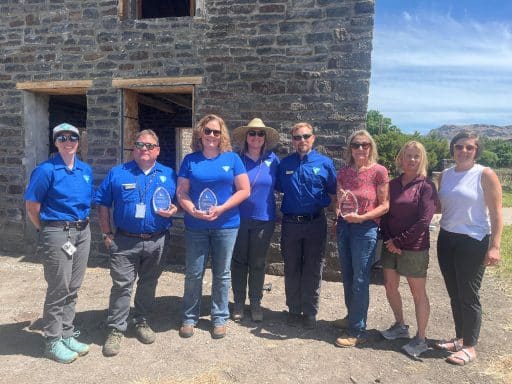
On a fittingly beautiful day in late May, a host of people gathered to celebrate the preservation and restoration of the Canyon Creek Stage Station near Mountain Home, ID, as representatives from the Stanley & Mildred Norstebon Family Trust and Idaho State & Four Rivers Field Offices of the Bureau of Land Management (BLM) received the third annual Idaho Heritage Trust (IHT) Fred Walters Award for Excellence in Historic Preservation.
Congratulations to all involved, and special thanks to Kirk Halford, former Idaho State Archaeologist and Project Lead on behalf of BLM, Cameron Hogin, Archaeologist with the
BLM Four Rivers Field Office, and Historic Architect Fred Walters for providing information and insight in the creation of this article.
—
Significance of Canyon Creek
Canyon Creek is located in southern Idaho eight miles north of Mountain Home. The creek and its tributaries generally flow year-round, creating a narrow, verdant canyon (hence the name) and welcome respite from the surrounding dry and rocky terrain. Nearby petroglyphs indicate the area was frequented by the Shoshone and Bannock tribes as part of their seasonal migration patterns, drawn by the same natural abundance that would go on to make the site a popular stop along the Oregon Trail and subsequent stage lines5.
Fur traders were the first non-Native American visitors to the area, arriving in the 1810s. They were followed by military expeditions in the 1830s, and then a series of missionaries, including Marcus and Narcissa Whitman. In the wake of a financial crisis in 1837, emigrants began heading West in the early 1840s in search of peace and prosperity. They followed roughly the same routes taken by these early trappers and missionaries, forming what we now know as the Oregon Trail5.
Simply getting to Canyon Creek was quite a feat for emigrants along the trail, however. In addition to the rampant disease and general difficulty of the trek (approximately 10% of travelers perished along the way), Canyon Creek requires crossing the Snake River. For much of its run, the Snake is ensconced in a deep canyon of its own with few opportunities to cross safely. The most popular and safest of these crossings was at Three Island Ford, near Glenns Ferry 40 miles southeast of Canyon Creek. Safer does not mean safe, however, as hidden holes in the silt, variable water levels due to rain and runoff, and unpredictable flow patterns claimed many wagons, livestock, and lives in an attempt to ford the river, even after the establishment of a ferry system9.
If the Snake River was too high at the time or the emigrating party extra cautious, they would avoid crossing altogether and follow the South Alternate Route, a harsh and sandy stretch of trail that was particularly inhospitable in the Summer months7. Those who successfully made the crossing, however, were treated to a relatively more comfortable trip along the Main Oregon Trail, with better access to water and grass for grazing, making it the more popular choice for travelers during the 1840s. Canyon Creek itself was a reward for travelers to risk crossing the Snake River – a veritable oasis amidst the dusty, arid landscape. Of the approximately 68,000 settlers who made their way toward Oregon, it is estimated that roughly 30-35,000 passed through Canyon Creek on their westward journey9.
Up until the early 1860s, few people decided to stay in Idaho, and simply passed through on their way to the Pacific. That all changed with the discovery of gold in districts east of Boise, where mines were established and the population boomed to support these ventures. In March of 1863, the first stagecoach service in the Idaho Territory was created and was followed closely by Ben Holladay’s Overland Stage Line, which provided service between Salt Lake City, Utah and Walla Walla, Washington5. By October of 1864, Holladay had established a station at Canyon Creek and accompanying bridge to make traversing the waterway much easier. As a result of the increased access from this and the completion of the Transcontinental Railroad in 1869, Canyon Creek became a popular fishing destination for the new leisure class, who raved about the abundant and abundantly delicious trout7.
Despite railroad expansion, fluctuation of stagecoach routes, and the development of the nearby Kelton Road as an alternative, Canyon Creek Stage Station remained a popular stop
for personal and commercial travelers for many decades.
History of the Stage Station
Archibald and Harriet Daniel and their large extended family initially emigrated to Idaho at the behest of the Northwestern Stage Company to run their stage station at nearby
Rattlesnake Creek5. Soon after arriving, they homesteaded a 160-acre parcel of land on Canyon Creek and hired a local man, Jack Slater, to build a station on the property2. In 1874, the station was constructed of locally sourced lava rock and was comprised of two interconnected buildings6. A living room and bedroom occupied one building, with three guest rooms on the second floor, while a kitchen and cellar were situated in the building behind, with a protected drive-through area separating the two buildings, providing a sheltered space for wagons and stagecoaches.
Harriett and Archibald, aided by their three sons and four daughters, threw themselves into a number of agricultural and subsistence ventures to support both themselves and the bustling stage stop. They cultivated an extensive orchard and garden, which provided fresh seasonal produce in such abundance to keep the larder stocked with canned fruits and vegetables throughout the leaner months. They fished the stream, hunted deer, and sowed corn, grains, and other feed crops for pack animals, leading a Boise reporter to attest they were “as fine crops of hay and grain as we have seen anywhere.5” Archibald himself dug a 16-foot well to ensure fresh, clean water year-round, and the family went so far as to plant hardwood trees to use for wagon repair.5
Through the 1870s and 1880s, Boise residents flocked to the “trout fisher’s paradise,” as they rediscovered what made Canyon Creek a natural gathering place for Native Americans for centuries before. This influx of pleasure seekers helped maintain the popular station, even as railroad expansion and the development of more direct routes led to a decline in stagecoach traffic5.
Archibald would sadly pass away on June 12, 1881, at the age of 73, followed by his wife, Harriett in January of 1897. They were buried in a small cemetery a few hundred yards southwest of the stage station. The enterprise persisted under the watchful eye of William Marion Daniel, the eldest son, until his death in 1921. Following the passing of his widow, the property changed hands several times throughout the 1920s and early 1940s. In 1965, Lloyd Hansen purchased the 90-year-old property, and lovingly restored the building, including “all of the original woodwork, rafters, and sills6.” Disaster struck in the early morning of December 14, 1976, when a short in the electrical wiring ignited a fire that would burn the entire stage complex to the ground, leaving nothing but the lava-rock walls5.
Acquisition by Norstebon Family and Coordination with BLM The station was nothing but a precarious pile of rubble when the Norstebon family took ownership of the property in the early 1980s. Despite its dilapidated appearance, the Norstebons were acutely aware of the station’s historical significance and immediately set to clearing brush and plants from the site to prevent further deterioration and erected a fence to protect the area. They soon realized, however, that they would need more help if they were going to realize their dream of restoring the station to its former glory2,3,5.
To this end, Anita Fickle reached out on behalf of the Norstebon family to a whole host of people who could possibly help. Katherine Kirk and IHT became involved in 2011 and employed renowned Historic Architect Fred Walters and a local structural engineer to assess the structure and develop a plan. It was his opinion at the time that it would be best to simply stabilize the structure and protect it against further deterioration. IHT awarded a grant to this end.
Ms. Fickle and the Norstebons dreamt of going even further and sought additional advice from IHT on the possible avenues available to pursue a full reconstruction of Canyon Creek. The Idaho Chapter of Oregon-California Trails Association (IOCTA) raised thousands of dollars , and IHT awarded another grant for masonry reconstruction in 2014 and introduced Budd Landon, historic mason, to the project.
It soon became clear that they needed an outside entity to take over management of the project and relevant piece of land. Neither Idaho State nor the local Mountain Home Historical Societies had the capacity to do so, but there was a distinct, if remote possibility the Bureau of Land Management (BLM) would be interested.
Jerry Eichhorst, preeminent Oregon Trail expert and IOCTA President, introduced the local BLM field manager to the site which began the conversation. Kirk Halford, Idaho State Archaeologist and BLM Manager, and the BLM National Trails Lead and Planner for Idaho was immediately intrigued by the site and charmed by Anita and the Norstebons, and he made a successful pitch to BLM’s State Director. At the same time, Ms. Fickle worked with an attorney to draw up a contract to donate Canyon Creek Stage Station and ¾ of an acre of surrounding land to be owned and managed by BLM in perpetuity3.
Inspired by the Norstebons’ determination to see the project through, as well as their own interests in historic preservation, BLM agreed to take on the project and property. Mr. Halford took responsibility for overseeing the project on behalf of BLM, writing yearly proposals, statements of work and grant applications to secure the funding needed from the BLM budget, IHT, and IOCTA to support reconstruction efforts at the site. The National Park Service’s Oregon Trail National office supported the project by preparing a comprehensive history (Frank Norris 2015) and interpretive plan for the site2.
The site officially came under BLM management in October of 2015, despite being far removed from any other BLM holdings, making it the smallest parcel of BLM land in history. Now the reconstruction work could begin in earnest.
Process of Preservation
Leading up to and shortly after the transferal of the property, two main questions remained: how can we resurrect this pile of rubble, and who can physically do the restoration work to the desired standard and remain within budgetary limitations?
At the behest of the Norstebons, IHT re-enlisted the services Fred Walters* to revisit the station with the aim of accurately restoring the site. Mr. Walters dug in, studying the only available historical photograph and physical evidence with meticulous attention to detail reminiscent of a storybook detective. If you take a very close look at the photo, you can see wood paneling through the windows and open door1. There is also written history indicating the Daniels hired a Finnish carpenter to do interior woodwork over a span of four months, which seems like a ludicrously long time for such a small space1,5. This, combined with a close examination of the remaining walls, led Mr. Walters to conclude that the folks responsible for the construction really knew what they were doing and were following common building practices at the time – not always a given with structures of a certain vintage, especially in the rough-and-tumble American West1.
Armed with enough firsthand evidence and broader context to inform conjecture, Fred devised an incremental plan to address areas of greatest concern and move from there. They began by stabilizing the existing walls, beginning with the gabled exterior walls, which were surprisingly sturdy despite deterioration near the top due to weather exposure. At this point, it was unclear if they would ever reach the point of rebuilding the roof, but anchor bolts were included in the plans for major support beams just in case1.
There was also the question of how much of the existing walls were salvageable and stable enough to build upon, what would need to be removed and remade, and what would have to be recreated. Fred enlisted the services of another longtime IHT collaborator, Historic Mason Budd Landon. “Budd really understood the concept of reconstructing a building as it was, not necessarily how it ‘should be,’” recalls Mr. Halford. After many days of hands-on research and discussion, a consensus was reached, and Mr. Halford secured funding for work to commence rebuilding the walls1.
Mr. Landon was able to salvage a great deal of basalt from the interior of the site and the rest had to be sourced from further up the canyon. At the same time, he took samples of the existing mortar to send out for analysis, which was determined to be comprised of clay from the bed of Canyon Creek, horsehair, and sand, and it had to be mixed to match the reddish-brown coloring1. “Thank goodness we had Budd [Landon], his love for the work kept our costs down and could not have led to a better result.”2
Without architectural plans to work from, Mr. Walters had to base the openings for doors, windows, and dormers on the available photograph, and planned the placement of fasteners to affix wood paneling to the interior of the stone walls1. The north wall and gables went up in 2016, with the south wall following suit in 2017.
The next piece of the puzzle was how to add the roof. Mr. Walters built a full-scale mockup of a corner of the roof where the slanted shoulder meets the wall. He and Mr. Landon fooled around with the model, adjusting the angles and contact points until they were satisfied with the results. The cornices proved to be a particular challenge, necessitating multiple cuts along two axes to fit correctly. The dormer windows were framed in next, which required doubling the rafters and installing a header above the dormer for stability1.
The final area of concern for Mr. Walters was the windows, which were a fairly standard 6×6 design typical of the late 1800s. Mr. Walters included a mullion insert (wooden separators between glass panes) that is indicative of 1873. Mullions are a fascinating way to date buildings in the 1800s, as they began nearly an inch thick at the beginning of the century, then continued to get thinner and thinner until the 1870s, when they began to thicken again. He utilized Mortise (slot) and Tenon (tab) joints to affix the mullions to each other and the surround frame, to provide a tighter fit and better insulation against the elements once windows are installed.
After two years searching for a contractor, Mr. Halford met Helaman Haynie, a contractor from Ogden, UT, who finally prepared a reasonable bid and finished the work in 2020. “Helaman was well versed in historic preservation as he had worked with Joe Gallagher (the LogDoc) who restored many buildings across the country. He understood the work and the need for maintaining the historic essence. And, as all those that make these projects possible, he appreciated preserving history and the historic fabric!”2
Mr. Halford recalls: “I really believed in the project, and the family was so kind – Anita Fickle especially was so great to work with. When we were out working on the station, people
would stop us to ask questions, and we were inspired by their excitement for saving our history. The fact that we took it on in the beginning was amazing, given all the issues at hand. I’m so thankful for how it worked out and thankful to the Norstebons for gifting their land in the first place. To a person, the enthusiasm for this project has been immense. From the family to BLM and the rest of the organizations, and particularly to the historic experts that really went above and beyond in making this project happen.”2
What Happens Next?
With the award-winning walls and roof intact, thoughts shift again to the future of Canyon Creek Stage Station. Cameron Hogin, Archaeologist with BLM’s Four Rivers Field Office, is in the process of securing a reasonable bid to install doors and windows, which is the next logical step in protecting the site from encroaching elements. Finding a capable contractor within budget constraints has proved difficult thus far, but all involved remain hopeful this is a momentary setback4.
In the meantime, five additional goals have been identified for the property: 1)Have the site listed on the National Register of Historic Places; 2) Remove accumulated debris; 3) Install
an interpretive sign discussing prehistoric use of the area, significance during the Oregon Trail and Overland Road eras, and the Daniels’ family and station history; 4) Landscaping
the area with the possibility of reintroducing the fruit orchard and/or garden; 5) Open it up to the Preservation Field School as a teaching site4.
—
Back in the 1960s and ‘70s, Martha Escuna lived at Canyon Creek and carried on its historic lineage as a gathering place and site of many an excellent party. There is an old fireplace at the back of the property that still has her name etched in it. Through the thankless work of everyone listed above and countless more volunteers, contractors, and concerned citizens alike, Canyon Creek was once again the site of a great get-together, and it is our sincerest hope that this was but the first of many more in the years to come.
* Mr. Halford and Mr. Walters had previously met at a Historic Preservation Workshop at the Bodie State Historic Park and National Landmark in eastern California, in the late 1990s. There Fred provided advice and encouragement on restoring a water storage building on Bodie Bluff, located on BLM above the historic mining town. The preservation project in the Bodie Hills provided Mr. Halford the first taste of historic preservation of an important piece of Bodie’s historic fabric. Inspired by Mr. Walters’ encouragement and the success of the project, Mr. Halford would go on to undertake eleven more historic preservation projects during his career, with Canyon Creek being the final feather in his cap before retiring and providing a nice bit of symmetry to his work as a federal archaeologist2.
Sources:
- Fred Walters, Conversation with the Author, June 2025
- Kirk Halford, Conversation with the Author, June 2025
- Katherine Kirk, Conversation with the Author, June 2025
- Cameron Hogin, Conversation with the Author, June 2025
- Canyon Creek Historical Narrative, Frank Norris, National Parks Service, 2008
- The Canyon Creek Station: A True Story of Heritage Heros, F. Kirck Halford, 2017
- Idaho State Historical Society Reference Series the Oregon Trail in Idaho – Number 50
- Maps – Oregon National Historic Trail (U.S. National Park Service)
- Oregon Trail Scenic Byway Three Island Crossing to Bonneville Point – BLM/IOCTA, 2009, Accessed via Wayback Machine 6/2025